Is it legal to play at casinos not on GamStop in the UK?
 Available in GB
The legal question gets asked far more often than it gets answered properly. People want a yes or no. The honest answer is that UK law treats the player and the operator very differently here, and the difference is the whole point.
This page works through the statute, splits the player side from the operator side, and ends on the part that matters most in practice: legal does not mean protected.
The full picture is in our guide to UK casinos not on GamStop.
Is the player breaking the law by using an offshore site?
No. There is no provision in UK law that makes it a criminal offence for a British adult to gamble on an online casino licensed in another jurisdiction. The duty to be licensed under UK rules sits on the operator, not on the customer.
That is the same answer you will get from gambling lawyers asked this in any neutral setting. It is also why the regulator, the UK Gambling Commission, frames its enforcement work as action against operators and the infrastructure that supports them, rather than action against players.
This is the part affiliate sites tend to get loosely right and then stretch into something they should not. “Legal” here means specifically that the player is not committing an offence. It does not mean the activity comes with the consumer protections that apply when you play at a UK-licensed site, and that distinction is where this page spends most of its time.

What does the law require of the operator?
This is where the actual legal hook lives. The framework is the Gambling Act 2005, which came into force in 2007 and remains the primary statute for gambling in Great Britain.
Under section 33 of that Act, providing facilities for gambling without the required operating licence is a criminal offence. The section is short and uncompromising, and it is the rule the Commission cites when it goes after unlicensed sites. You can read the Act itself on legislation.gov.uk.
For a long time, this rule had a practical limit. It only bit on operators with some physical or business presence in Great Britain. Sites based purely offshore could and did serve UK customers without a UK licence, and the law could not reach them in any meaningful way.
That changed with the Gambling (Licensing and Advertising) Act 2014, on the statute books as chapter 17. It came into force on 1 November 2014 and rewrote the test. Any remote operator transacting with British customers must hold a UK Gambling Commission licence, regardless of where the operator is based, and advertising of unlicensed remote gambling to the British market is restricted. The full text of the 2014 Act is on legislation.gov.uk, and the Commission’s own guidance on this primary legislation sits on gamblingcommission.gov.uk.
So the law on the operator side is unambiguous. An offshore casino accepting UK players without a UK licence is, from the British regulator’s point of view, operating outside the law. The fact that it has a Curacao or Anjouan licence is irrelevant to the UK test, because the UK test is about UK customers.

How can a player be legal but the operator illegal?
It looks contradictory until you remember which side the duty falls on. The legal duty under the Acts above falls on the people providing the gambling, not on the people doing the gambling. A driver does not commit an offence by being a passenger in a vehicle whose operator failed to register; the analogy is rough but it captures the asymmetry.
This is why enforcement looks the way it does. The Commission does not pursue UK customers of offshore casinos. It pursues the offshore casinos themselves, their payment infrastructure, their advertising and their search visibility. Its public blog on tackling unlicensed gambling on gamblingcommission.gov.uk describes that approach in its own words.
That is the actual legal landscape for a UK player thinking about offshore play. No offence is committed by playing, but every protection that the UK licensing framework provides is missing.
What does “legal but unprotected” actually look like?
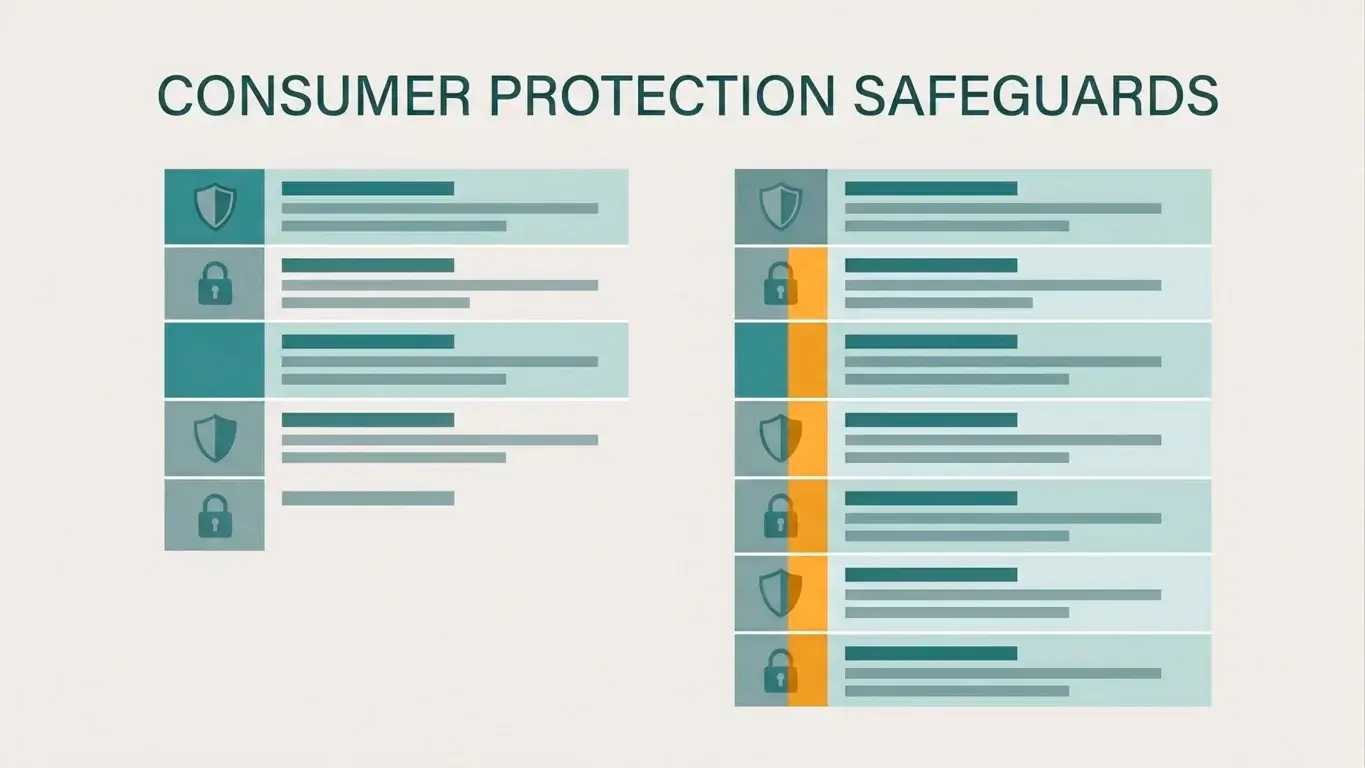
This is the part worth slowing down on. The UK consumer-protection package that a licensed remote operator must give a player is not theatre. It includes a long list of things you only notice when they are missing.
The list is long enough that pulling out the most concrete items helps. The ones below are the ones that vanish the moment you step outside a UK Gambling Commission remote licence.
- UKGC oversight
- If you have a complaint about a licensed operator that you cannot resolve directly, the Commission can take regulatory action, fine the operator and in serious cases suspend or revoke the licence. Offshore licensors do not have that authority in the UK.
- Mandatory fund segregation
- UK-licensed operators are required to disclose how they ring-fence player funds and at what level of protection. Cheap offshore licences typically impose no such requirement, so player balances can sit on the same accounts as the operator’s working capital.
- Affordability and stake controls
- UK rules now include financial vulnerability checks when net spend exceeds £150 over 30 days and per-spin slot caps of £5 for those 25 and over and £2 for those aged 18 to 24. None of those apply on an offshore site.
- Self-exclusion through GamStop
- The whole reason this entire site exists is that how GamStop works only extends as far as the UK licensing perimeter. Past it, no.
- Alternative dispute resolution
- UK-licensed operators must be members of an approved ADR scheme for disputes the operator cannot resolve. Offshore operators may or may not have anything comparable, and what they do have is enforced by their own home jurisdiction, not by the UK.
What about tax on winnings?
UK law does not tax gambling winnings in the hands of the player. That has been the position since 2001, when Gordon Brown moved the tax burden from punters onto operators, and it applies to all winnings regardless of where the operator is licensed.
So winnings from an offshore casino are not taxable to a UK resident as gambling income, in the same way winnings from a UK-licensed casino are not. This is one of the very few details on which the affiliate field is consistently correct.
The caveat is the surrounding income. Interest earned on winnings sitting in a savings account is taxable. Earnings from related activity such as streaming, sponsorships or selling tips are taxable. The exemption is specific to the gambling outcome itself.

How active is enforcement against offshore operators?
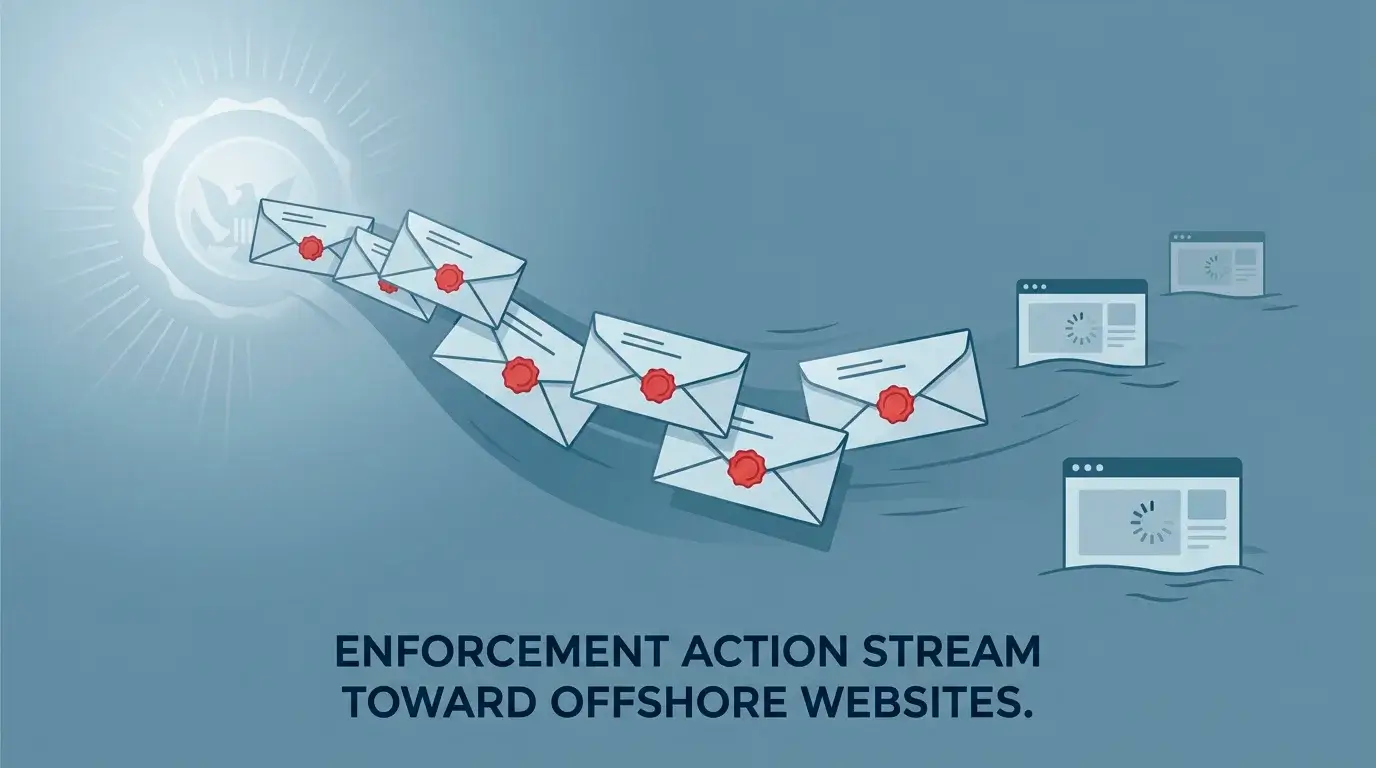
More than it used to be. The Commission’s public messaging in the last two years has been consistently focused on the unlicensed market, and the figures it has shared point to a sustained programme rather than one-off cases.
Across recent reporting cycles, the Commission has issued hundreds of cease-and-desist notices to unlicensed sites, requested takedowns and geo-blocks against more than a thousand domains, and worked with search engines on removing tens of thousands of URLs pointing to unlicensed gambling. The exact figures published differ by reporting window and by spokesperson, which is why this page does not pin a single number on a specific year.
An Illegal Gambling Taskforce, announced for the 2026 cycle, brings UK authorities together with major payment and platform companies. Its remit is the supporting infrastructure for offshore operators: payment rails, advertising and search exposure.
None of this changes the player-side legal position, but it does change the practical landscape an offshore site operates in. Payment-processing reliability, search visibility and advertising channels into the UK market are all in flux. For a deeper look at the operator landscape, the page on offshore jurisdictions covers the licensing side in detail.
Does the legality answer change if you are currently self-excluded?
The strict legal answer is the same: no offence is committed by a UK adult playing on an offshore site, including someone currently on GamStop. The licensing duty falls on the operator either way.
The practical and personal answer is very different, and worth being honest about. Self-exclusion is, by design, a request to be stopped. The reason people register is usually that play was causing harm. Stepping around the technical block by using an offshore site is technically lawful and very often deeply unhelpful.
If the impulse to look for non-GamStop sites is showing up during an active self-exclusion, that is exactly the situation the dedicated page on the proper way to leave GamStop is built around. It covers cooling-off, identity re-verification and the layered TalkBanStop tools designed for those moments.
What is the workable summary you can keep in your head?
Two lines. A UK adult playing on an offshore casino is not committing a criminal offence. An offshore casino accepting UK customers without a UK Gambling Commission licence is.
What the scheme itself covers: how GamStop works.
That asymmetry is why the search continues to exist, and why so many of the practical questions that ride along behind it — safety, payments, dispute resolution, withdrawals — end up being more important than the bare legal question. The other pages in this cluster pick up where this one ends.
If you came here from the main guide, the next logical stop is the official removal page if self-exclusion is part of your story, or the offshore-casino licensing pages if you are simply trying to understand who these operators are.
This material was created by the GamStop Navigator Slots team.
Related posts

Casinos not on GamStop: your questions answered
Can UK banks block gambling payments, and how does TalkBanStop help?